The logistics of converging threats: why integrated security is the new baseline
Cargo theft across global supply chains is no longer defined by opportunistic break-ins. Criminal groups now combine physical intrusion, identity fraud, digital deception and insider knowledge to intercept shipments through methods that appear entirely legitimate. As criminal methods become more interconnected, organisations are rethinking security as an integrated operational model rather than a collection of isolated controls.
For decades, cargo security was largely about protecting your assets against physical threats. Today, the transport and logistics sector is confronting a structural shift in how cargo crime operates. While physical intrusion still accounts for the majority of recorded incidents, criminals have evolved their methods. Identity fraud, phantom carrier operations and credential theft now sit alongside traditional forced entry, and in many cases, these methods overlap within a single attack. The result is a converging threat landscape that combines physical, digital, fraud and insider risks, reinforcing each other across interconnected systems.
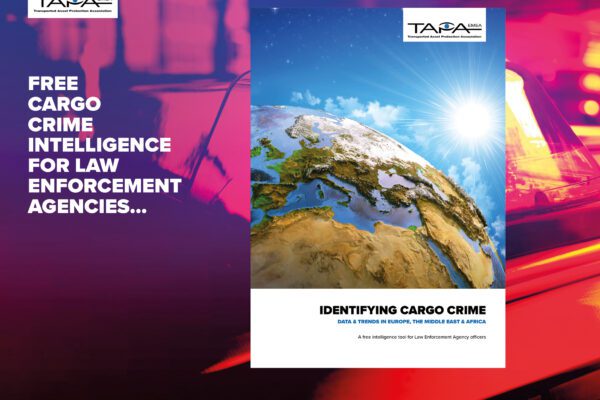
In a joint warning published by TAPA EMEA on 3 February 2026, their cargo crime intelligence database recorded over 108,000 thefts from supply chains in more than 110 countries across Europe, the Middle East and Africa in the previous two years. Only 5% of these crimes reported a loss value, yet those recorded losses exceeded €1 billion, indicating that the true scale of cargo crime is likely substantially underreported.
Converging and multi-layered threats
Securitas has been working with transport and logistics organisations globally for decades. The patterns emerging from that work reveal a threat that is becoming more calculated, more layered and harder to detect using conventional security models.
- Physical intrusion remains prevalent, but what criminals target has changed. A significant shift is the target profile. Dieter Blommaerts, Director of Standardised Solutions, Securitas Europe, says, “Recent years have proven that vital cargo is not limited to high-value items such as luxury or branded goods. Goods that are essential, in high demand, or easily resold are increasingly targeted by criminals. For example, food and drink products were the most targeted product category reported in TAPA EMEA’s Vigilant magazine (May 2026 edition). As a result, transport and logistics companies need to elevate security measures regardless of the cargo their fleets are carrying.”
- Identity fraud and digital deception are accelerating faster than the industry’s ability to distinguish authentic information from fabrications in many cases. Across global markets, AI-generated documentation and cloned carrier identities are enabling criminal groups to collect shipments under the guise of legitimate transport, exploiting weak and isolated verification procedures.
Morten Krohn Sommer Mikkelsen, Vice President Standardised Offering, Securitas Europe says,
Our integrated security model is designed to give people on the ground the ability to make informed decisions in real time. A client in the pharmaceutical industry, for instance, was facing a rising threat of criminals impersonating customs officials and police officers to intercept vehicles on the road. We implemented a solution that connects drivers directly with our Security Operations Centers (SOCs). If a driver is stopped, they verify the legitimacy of the request through our SOC network before releasing any cargo. That real-time connection between the driver and the operations centre is what changes the dynamic.
- Insider threats and weak access control can have a compounding effect on every other threat category. Supply chain environments are particularly vulnerable where access management and segregated security measures are not enforced. Insiders don’t steal directly but provide schedules, routes, and security gaps that enable targeted, high-value attacks.
- Cross-border complexity creates systemic blind spots. The recent rise of geopolitical tensions and tightening border restrictions are compounding operational risk for transport and logistics operators. Shipments crossing multiple jurisdictions, handled by numerous logistics partners, generate data across disconnected systems. Criminal groups exploit this fragmentation while operating freely across borders by using both cyber and physical methods to remain undetected.
The need for end-to-end security
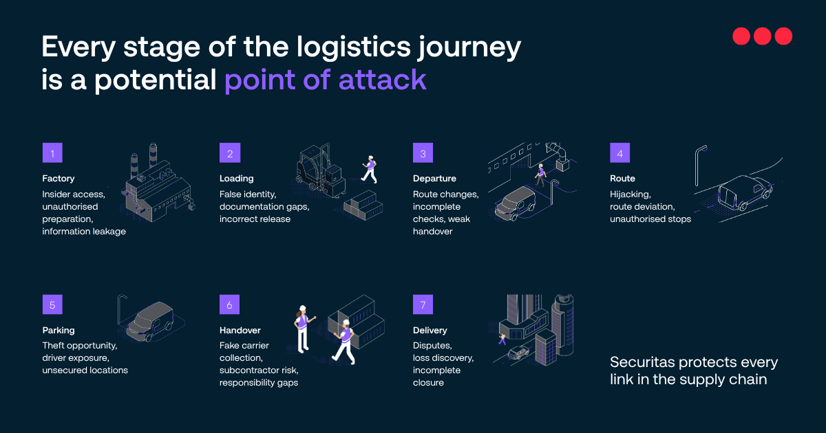
By exploiting vulnerabilities from facilities and vehicles to parking locations, cargo criminals are already thinking end-to-end. Our security models must do the same to connect and protect every link in the journey.
At loading, control access, confirm identity, check cargo status, validate release instructions and approve departure. Every handover is a security event.
Before departure, confirm that tracking devices, locks and sensors are functioning correctly; verify that the trailer is secured and armed; and ensure that the driver has the approved route and secure parking address.
On the road, monitor location, route adherence, unauthorised stops, door activity, trailer status, signal integrity, driver welfare and unexpected deviations, and apply predefined procedures to respond to alarms and irregularities.
At parking or rest points, assess whether the chosen location reduces exposure or increases it, before the vehicle stops.
At delivery, confirm that the vehicle, driver and cargo are where they should be, and stop monitoring only when the appropriate conditions have been met.
Mikkelsen says, “The transport and logistics sector does not lack security technology. What many organisations lack is a connected model that turns signals into decisions across the full cargo journey. That is the gap we focus on closing.“
Why integrated security matters more than isolated processes and technologies
Mikkelsen says, “We are seeing the highest security success rates in organisations that have moved away from managing security as a collection of standalone set-ups to building a connected model that links intelligence, monitoring, and response across the entire cargo journey.
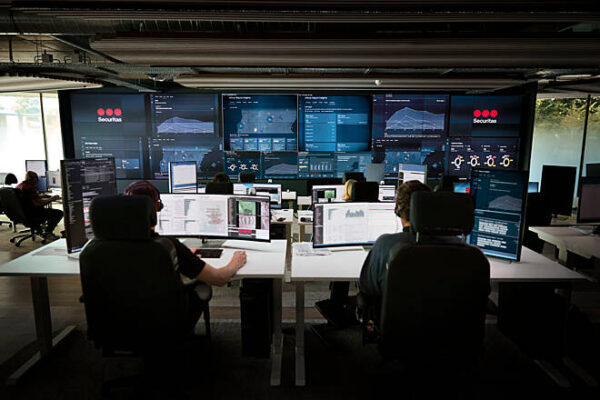
We work with transport and logistics leaders to build a connected model that spans the full spectrum of security: from our SOCs, electronic security, and access control to remote video solutions, fire and safety, and track and trace capabilities, including lone worker protection. By linking these with on-site guarding, escort security services, and mobile response, we connect every layer into a single operating framework.”
In practice, this connected security model provides organisations with greater oversight, verification capability and control.
Turning TAPA standards into integrated security outcomes
Blommaerts says, “While TAPA’s industry standards (FSR, TSR, PSR and CSS) provide an operational framework for the supply chain, we build connected security programmes around those standards to serve not just as a compliance exercise, but as the foundation for measurable resilience.”
1. Facility Security Requirements (FSR)
Warehouses, logistics hubs and distribution centres remain prime targets. Securitas designs and operates FSR-aligned security combining digital visitor management, remote video surveillance, on-site guarding, mobile patrols and alarm handling through centralised operations centres.
| Case Study: Protecting a logistics hub from external and internal threats |
| A logistics operator was establishing a new distribution hub handling high volumes of goods moving through multiple loading and dispatch areas. The challenge was not simply protecting the perimeter, but maintaining visibility and control over vehicles, visitors, contractors, and employees across a large and complex operational environment. Securitas designed an FSR-aligned security programme combining access control, remote video surveillance, visitor management, and Security Operations Center (SOC) oversight into a connected operating model. Access rights, site activity, and security events were continuously monitored and verified, allowing operators to identify anomalies and respond before incidents could escalate. The result was greater operational control, improved protection against unauthorised access and insider risk, and a security framework that supported business operations while strengthening overall resilience. |
2. Trucking Security Requirements (TSR)
Securitas supports TSR-aligned operations through 24/7 SOC monitoring, real-time vehicle tracking, risk-informed routing using historical incident data, and driver protection with emergency communication and welfare monitoring. Every signal is assessed against predefined escalation procedures, distinguishing routine activity from genuine security incidents.
| Case Study: Protecting drivers and cargo throughout the journey |
| A transport operator needed to improve the safety of drivers and the security of cargo moving across multiple countries and risk environments. Traditional tracking tools provided location visibility but offered limited capability to verify incidents or coordinate a rapid response when drivers encountered threats or unexpected events. Securitas implemented a TSR-aligned solution connecting vehicle tracking, driver communication, emergency escalation procedures, and 24/7 SOC oversight. Security operators continuously monitored journeys, assessed alerts in real time, and coordinated response actions whenever intervention was required. When a driver experienced a medical emergency during transit, the integrated solution enabled immediate verification, escalation, and dispatch of emergency services to the vehicle’s exact location. The incident demonstrated how connected monitoring, verification, and response capabilities can protect both drivers and cargo throughout the transport journey. |
3. Parking Security Requirements (PSR)
Securitas supports PSR-compliant facilities with controlled access, remote video surveillance, SOC-led patrols, driver safety systems and mobile patrol intervention.
| Case Study: Creating a secure stopping point for drivers and cargo |
| A logistics operator required a secure truck parking facility where drivers, vehicles, and cargo could remain protected during mandatory rest periods. With limited on-site resources, maintaining security, controlling access, and responding quickly to incidents presented a significant operational challenge. Securitas implemented a PSR-aligned solution combining remote video surveillance, controlled access, driver communication, and 24/7 SOC monitoring. Vehicles and drivers were verified before entry, site activity was continuously monitored, and operators could intervene immediately whenever suspicious behaviour or security incidents were detected. Rather than relying on standalone technologies, the client gained an integrated security capability that improved driver safety, strengthened control of site access, and reduced exposure to cargo theft and unauthorised activity. |
Together, these three standards create a security architecture that covers the full scope of the cargo journey and, when implemented together, reduce opportunities for security gaps.
Today’s challenge and opportunity for transport and logistics leaders
Blommaerts says, “The organisations proving most resilient to modern cargo crime are those building connected models that link data across facilities, vehicles, routes and people, creating continuous visibility rather than relying on separate, administrative snapshots.”
The question facing transport and logistics leaders is no longer whether their cargo is at risk. The question is whether their security model reflects how that risk actually operates today. With intelligence, an end-to-end framework and the right partner, the balance shifts from responding to incidents towards anticipating them, and that shift is where resilience begins.
At Securitas, we are taking the security industry into the future. We bring together our expertise in individual services such as Remote, Mobile and On-Site services, Fire & Safety and Technology into innovative security solutions to meet our clients’ diverse needs. Just like your business, our security solutions are built to adapt and grow. And with a truly global presence, we are proud to be a trusted security partner to businesses all over the world.
Get in touch