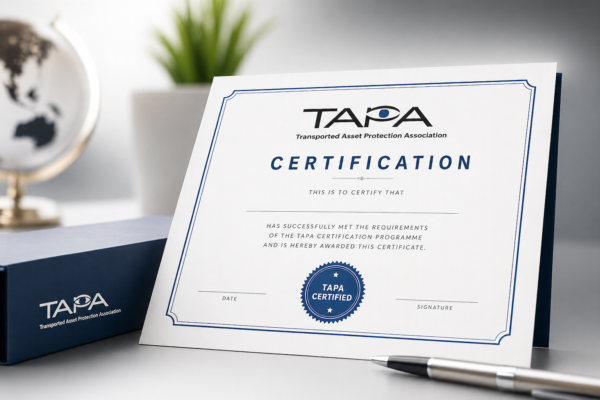
TAPA’s Certification Program provides a globally recognized framework for protecting facilities, transport, and parking operations against security threats.
Members can choose between Single-site, Multi-site, and Self-certification options to meet the required security standards.
TAPA Certification Process
Step 1: Define Your Security Level
All certifications are based on one of three TAPA Security Levels:
- Level A (1) – High Security Protection
For facilities or operations in high-risk environments requiring the strongest controls. - Level B (2) – Medium Security Protection
For operations needing a balanced level of security and efficiency. - Level C (3) – Standard Security Protection
For lower-risk environments; this is also the entry level for self-certification.
Further information and details about TAPA Security Levels (A, B, C) and their protection requirements can be found in the respective standard documents:
FSR: Facility Security Requirements 2023
PSR: Parking Security Requirements 2023
TSR: Trucking Security Requirements 2023
Please note that for the Cyber Security Standard there is only one Security Level possible, which needs an IAB audit.
Step 2: Choose Your Certification Option
TAPA offers three certification routes for its Facility (FSR), Trucking (TSR), and Parking (PSR) Security Standards:
- Single-site Certification
Each facility is individually audited by a TAPA-approved Independent Audit Body (IAB). - Multi-site Certification
Multiple locations operating under a central security management system managed by a central function.
The IAB conducts annual sampling audits to ensure ongoing compliance. - Self-Certification
Available for FSR Level C, TSR Level C, and PSR Level C.
Conducted by a TAPA-trained Authorized Auditor (AA) within your organization and free of charge for TAPA members.
Further information can be found here: Standard Self-Certification
Step 3: Assign a TAPA-Trained Auditor
Every organization applying for certification must have a TAPA-trained and approved auditor:
- LSP Authorized Auditor (LSP AA) – an internal employee who has completed official TAPA Standards training and passed the associated exam.
If no internal auditor is available, companies may engage an external Independent Audit Body (IAB).
This requirement applies to all certification levels (A–C for FSR, Levels A–C for TSR and PSR).
Further information on independent audit bodies can be found here: TAPA IAB’s
Further information to trained auditors can be found here: TAPA Trained Auditors
Step 4: Conduct the Audit
After defining the security level and certification type, the organization must:
- Prepare the required documentation and evidence.
- Complete the official TAPA Audit Form
- Submit the completed audit via TAPA’s online platform.
If all requirements are met, the facility or organization receives an official TAPA Certificate, valid for three years.
Further information for comprehensive instructions on the audit process, auditor roles, and required documents can be found here: TAPA FSR 2023 Certification Framework Document
Step 5: Corrective Actions & Waivers
If non-conformities are found during the audit, a Security Corrective Action Requirement (SCAR) must be completed within 60 days.
If specific requirements cannot be fully met, a Waiver may be requested — a written TAPA approval allowing alternative security measures valid for the certification period.
Step 6: Maintain and Renew
Certified members are required to:
- Perform annual internal self-audits to maintain compliance.
- Close any identified gaps within 60 days.
- Schedule re-certification at least three months before the current certificate expires to prevent lapses.