Training tracker ensures TAPA EMEA’s security Standards’ support is ‘fit for purpose’
In the last 3 years, TAPA EMEA has provided training for nearly 5,000 security and supply chain professionals to support their adoption of the Association’s FSR, TSR, PSR, & CSS Standards. But how does it ensure its training provision is fit-for-purpose and meets users’ expectations?
For over 20 years, TAPA’s supply chain security Standards have been underpinning the Association’s core mission: to minimise losses from supply chains.
For many companies shipping products across the globe, working with TAPA-certified Logistics Service Providers is an essential part of their supply chain resilience strategy. And to those transport and logistics operators which have made a commitment to certification, compliance with TAPA’s Facility Security Requirements (FSR), Trucking Security Requirement (TSR), Parking Security Requirements (PSR), and now, Cyber Security Standard (CSS) is a sign of their determination to protect products entrusted to them across each client’s end-to-end supply chain.
Today, TAPA Standards’ certifications in Europe, the Middle East & Africa are at their highest-ever level, but encouraging more companies to use the Standards is a constant focus of the region’s leadership. This goal also sits with the buyers of transport and logistics services who, ultimately, have the greatest influence over their suppliers when it comes to asking if they are TAPA-certified or requesting that they meet one or more of the Standards.
Companies that do step up to meet TAPA’s requirements can be assured of the Association’s full support.
Underpinning the Standards in the Europe, Middle East & Africa region is an increasingly comprehensive, multi-lingual training programme developed by TAPA EMEA’s Standards & Training Team, which also provides ongoing support and guidance to companies working their way through the certification process.
The training programme is also given the ultimate sense-check throughout the year to ensure it is fit-for-purpose. The insight comes from security and supply chain professionals who have been through the training via a survey at the end of the programme, timed to gather feedback while it’s still fresh in their minds.
To find out more, Vigilant invited the Training team to tell us more about the survey and its latest findings…
How many surveys were completed in this latest analysis?
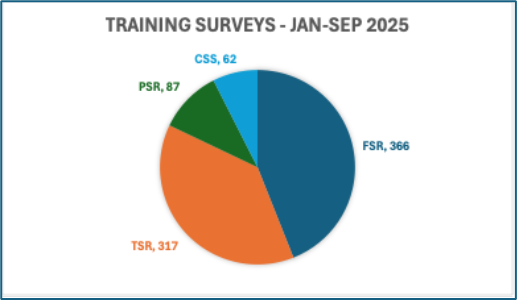
The latest TAPA EMEA Standards’ training analysis represents a comprehensive assessment of supply chain security implementation across the region during the first nine months of 2025, drawing from a substantial dataset of 832 completed surveys covering responses from 366 Facility Security Requirements’ (FSR) assessments – representing the largest segment of the survey population and reflecting the critical importance of secure warehousing and distribution facilities in modern supply chains. Additionally, the analysis incorporates 317 Trucking Security Requirements’ (TSR) training evaluations, highlighting the ongoing focus on transportation security amid evolving cargo theft threats, and a further 87 Parking Security Requirements’ (PSR) surveys that address the vulnerable periods when vehicles are stationary. For the first time, we also gathered feedback from 62 Cyber Security Standards’ (CSS) trainings focusing on cybercrime prevention and cyberattacks on supply chain security related information.
This robust collection of survey data provides valuable insights into current security practices, compliance trends, and emerging challenges across different sectors of the supply chain ecosystem. The nine-month timeframe captures both seasonal variations in security implementation and the evolving threat landscape that TAPA EMEA members face throughout 2025. These findings offer member organisations critical benchmarking data to enhance their security posture, identify best practices, and strengthen operational resilience while maintaining competitive efficiency in an increasingly complex global supply chain environment.
Based on the survey data across the four TAPA EMEA Standards (FSR, TSR, PSR, & CSS), the training programmes demonstrate consistently strong performance with predominantly positive participant feedback. The results reveal satisfaction rates consistently exceeding 80% across all Standards, with most categories achieving satisfaction levels between 85-95%. This high level of positive response indicates that the fundamental structure and content of TAPA EMEA’s training modules are effectively meeting participant expectations and learning objectives. The consistency of positive feedback across different Standards suggests that the association’s standardized approach to training design and delivery is working well across diverse subject areas.
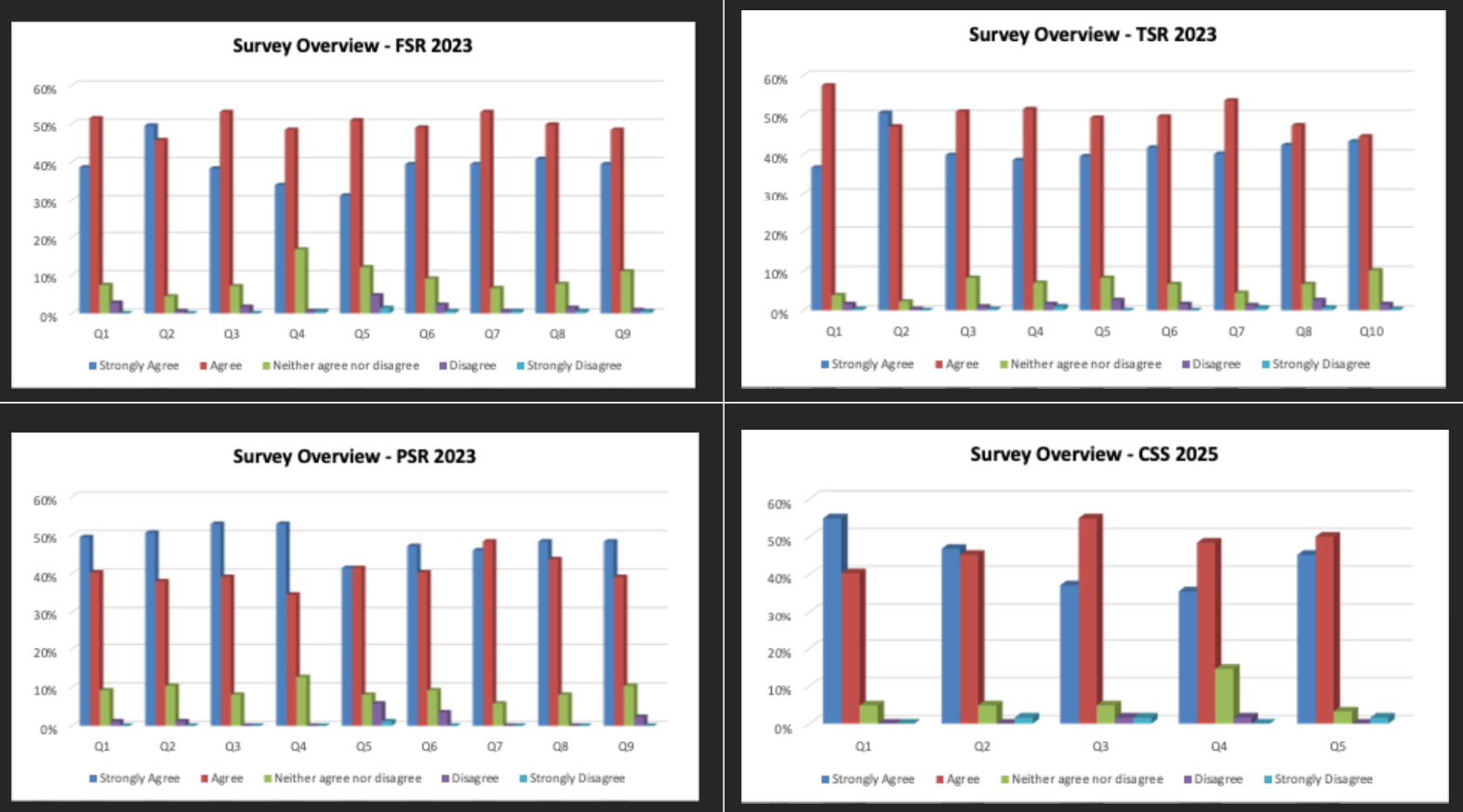
While the overall feedback is overwhelmingly positive, the survey results also highlight areas for targeted improvement, with negative feedback typically representing less than 15% of responses across most categories. The modest levels of constructive criticism provide valuable opportunities for refinement without indicating systemic issues with the training programmes. Notably, the feedback patterns show that while participants are generally satisfied with content quality and relevance, some of the improvement areas align with identified concerns such as platform usability, interaction levels, and material consistency.
Tel us more about how the survey feedback identifies opportunities to improve TAPA EMEA’s trainings?
The TAPA EMEA Standards’ training survey incorporates both structured assessment questions to evaluate training effectiveness and an open-ended feedback section designed to capture participant suggestions for improvement. This open question format provides trainees with the opportunity to propose specific activities, methodologies, or content modifications that could enhance future training sessions. By soliciting direct input from participants, the survey not only measures training performance but also creates a collaborative framework for continuous improvement, allowing the experiences and insights of trainees to directly inform the evolution of TAPA EMEA’s training focus.
Can you share some examples where training feedback has been adopted into the training modules?
We have a strong commitment to incorporating participant feedback into the continuous evolution of our trainings.
For example, one of the first requests received by TAPA EMEA related to the absence of a dedicated Security Risk Assessment training module. This has since been incorporated into the training curriculum for several years now.
Another significant suggestion from trainees was the need for a dedicated module highlighting frequent audit failures and prevention strategies. TAPA EMEA already addresses this concern through comprehensive video summaries at the conclusion of all training programmes, which demonstrate effective standard audit procedures for each respective Standard. However, recognising the value of this feedback, we plan to enhance these existing resources with additional content specifically focused on common audit pitfalls and avoidance techniques.
Additional feedback has led to practical operational enhancements that directly improve the learner experience. Trainees requested advance knowledge of module completion times to better plan their learning schedules, a straightforward modification that the training team is currently reviewing for implementation across all programmes. While the asynchronous nature of the training allows participants to progress at their own pace without pressure to complete modules in single sessions, providing time estimates enables better personal scheduling and expectation management.
Furthermore, calls for increased course interactivity have prompted the TAPA Training team to actively investigate future opportunities for enhanced engagement, demonstrating how participant input directly shapes the strategic direction of our programme development and delivery methods. A hands-on experience of this “training interactivity” request is the offering of monthly training webinars for FSR and TSR that allow trainees to have a two-hour live and fully interactive session per Standard with a member of the Standards & Training Team. This enables us to answer any questions from the training, present the exam environment to trainees, prepare them for the exam, and finally discuss in real-time the findings of the case studies. This then gives them the opportunity to express their views related to the application of the Standards.
Are there any suggestions from training participants that you expect to be carried forward into the updated trainings for the new 2026 versions of the TAPA FSR & TSR Standards?
The survey results we receive provide valuable insights into how we can further enhance the training experience and its overall effectiveness. In the latest feedback, participants emphasised the importance of more intensive interaction between trainers and trainees throughout the entire training process, not just during webinar sessions. This reflects a desire for more personalised support and guidance.
Additionally, feedback suggested re-evaluating the current balance between AI-generated presentations and live trainer-led instruction. Many participants see human expertise as a key added value, especially when it comes to delivering complex technical content effectively.
Another constructive point raised concerned the consistency of translated examination materials. Participants identified discrepancies between the translated exam content and the corresponding translated Standards’ documentation, an area we will now review and improve.
These findings collectively point to the importance of maintaining human-centered learning experiences while ensuring linguistic accuracy and coherence across all multilingual training components. Following the finalisation of the 2026 Standards’ revision process, all these topics shall be addressed in preparing the new training material.
Can you provide any insight into any major changes you foresee to the 2026 Standards’ training modules?
Looking ahead to the training modules for the 2026 Standards, TAPA EMEA is currently evaluating various improvement opportunities that could be implemented once the Standards’ revision process is complete and the development of new training materials begins.
One key consideration is the migration to a new, more user-friendly training platform designed to enhance the overall learning experience and accessibility for all participants. This platform would serve as the technical foundation for incorporating selected improvement suggestions identified through participant feedback – such as increased interaction between trainers and trainees, a more balanced integration of human instruction with technology-based content delivery, and improved consistency across translated materials.
The goal is not only to align the 2026 training modules with the revised Standards, but also to meaningfully integrate the collective experiences and feedback from the training community to create a practical and engaging learning experience.
Other than completing the training survey, how else can participants provide feedback to TAPA EMEA?
Beyond the formal survey mechanism, participants have multiple avenues to provide detailed feedback to TAPA EMEA throughout their training journey. At the initiation of each training programme, contact details for the Standards and Training team are explicitly provided to all trainees, enabling direct communication channels for immediate concerns or suggestions. This open-door policy has proven effective, with trainees frequently utilising direct email communication to report issues identified during the training process, whether related to content clarity, technical difficulties, or material inconsistencies.
This real-time feedback approach allows TAPA EMEA to address concerns promptly and make necessary adjustments in line with our commitment to responsive and collaborative educational improvement. All emails received are answered by the TAPA Standards and Training team, establishing an effective communication channel between trainees and the Association.
In addition, TAPA EMEA is already actively working on a new web application to make the registration process and the management of member vouchers and purchased training slots significantly more user-friendly. This application is expected to play a central role in organising and streamlining training processes, while also improving transparency and efficiency for all stakeholders.